
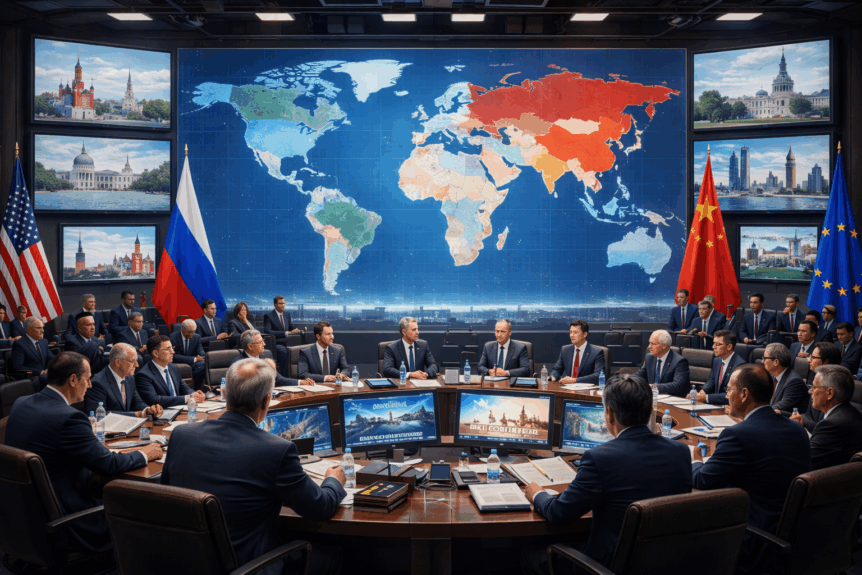
As we move through January 2026, the global landscape isn’t just “shifting,” it’s being fundamentally rewired. For investors, the era of pure market efficiency has given way to an era of geostrategic necessity. When I look at the current volatility, it’s clear that government policy is now a bigger driver of returns than company earnings.
At Wealthnest Planners, we believe a well-crafted financial plan must account for these macro headwinds without chasing every headline. Below are the four geopolitical trends defining the start of 2026 and how we are helping our clients navigate them.
The “Sovereign AI” Pivot
The competition for AI dominance has moved past software. In 2026, governments are treating AI assets, compute clusters, training data, and energy grids, as critical national infrastructure.
- The Trend: We are seeing the rise of “Sovereign AI.” Just this month at Davos, the UK announced partnerships to build defense-specific open-source tools, while nations across the EU and Asia are scaling “AI Factories” to keep data and processing within their own borders.
- The Strategic Shift: The focus is moving beyond the “Magnificent Seven” toward the infrastructure of sovereignty. This involves the complex intersection of local data center development, nuclear energy, and grid modernization. Finding the right entry point in these sectors requires a deep dive into local regulations that go far beyond standard stock analysis.
US-China: The “Frenemy” Economy
The headlines are currently dominated by a “trade ceasefire,” but for a serious investor, the reality is a rollercoaster of transactional deals and hidden restrictions.
- The Trend: While we see surface-level deals involving soybean purchases and social media solutions, the underlying “decoupling” is accelerating. New restrictions are tightening around biotech and high-end semiconductors even as a temporary trade peace is maintained.
- The “Connector” Concept: Because direct trade is becoming more difficult, countries like Vietnam, Mexico, and Malaysia are acting as vital links. They are no longer just “emerging markets,” they are the essential middlemen of the global economy.
Latin America: The “Monroe 2.0” Corridor
2026 is a massive election year for the Western Hemisphere, and the tide is turning sharply toward a new era of regional cooperation.
- The Trend: The “Pink Tide” of leftist governments is receding. Following Chile’s rightward shift and the recent geopolitical changes in Venezuela, the region is moving toward market-friendly policies. We are seeing Latin America pulled back into a US-aligned security and resource corridor.
- The Strategic Focus: Critical Minerals. As the U.S. builds a battery supply chain independent of China, the “Lithium Triangle” and copper mines of Peru and Chile have become strategic assets. However, political stability in these regions remains a moving target, requiring a disciplined approach to exposure.
The Israel-Iran “Risk Decoupling”
The Middle East remains a flashpoint, with tensions escalating as a US carrier group arrived in the region this week. Yet, the market’s reaction has been surprisingly nuanced.
- The Trend: We’ve entered a “post-scarcity” regime for oil. Despite the military posturing, oil prices have remained stable due to record supply from the Americas. The old “rules” of how conflict impacts energy prices are being rewritten in real-time.
- The Strategic Focus: Defense and Resilience. While energy isn’t the “fear trade” it once was, global rearmament is a multi-year structural trend. The challenge for investors is identifying which firms have the backlogs to weather a potential cooling of tensions versus those built for a “forever war” footing.
The Pragmatic Bottom Line
In 2026, the biggest risk isn’t volatility, it’s fragility. Whether it’s a single country, a single tech stack, or a single energy source, the “new global order” punishes portfolios that are over-concentrated.
At Wealthnest, we specialize in identifying “un-correlated” assets that help ensure your portfolio reflects the world as it is today: fragmented, interventionist, but full of opportunity for those who have a map.